
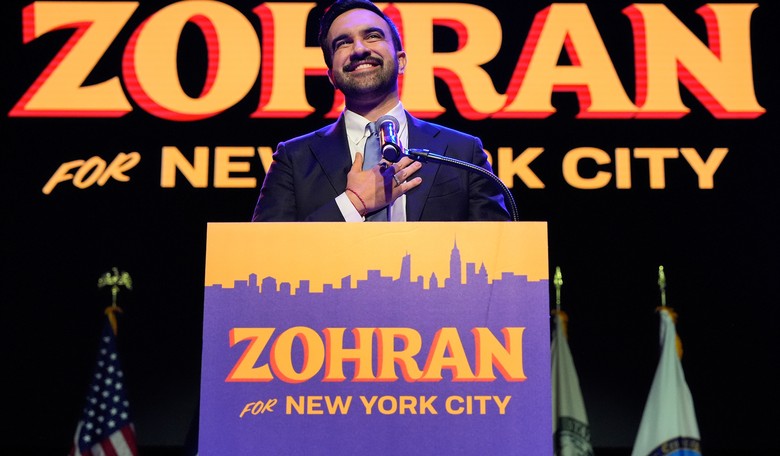
Zohran Mamdani wants you to believe his five city-run grocery stores are simply entering the arena of fair competition.
It's a nice line but it isn't even remotely true. What Mamdani is actually building is a monopoly, just not the kind most people picture when they hear the word. The government is setting the rules, subsidizing the rent, waiving the taxes, and removing any requirement to ever turn a profit. But underneath all of that sits a second, rarely discussed monopoly: a monopoly on consumption itself.
"Now, some will insist that city-owned businesses do not work, that government cannot keep up with corporations," Mamdani said earlier this year. "My answer to them is simple: I look forward to the competition. May the most affordable grocery store win!"
Mamdani said it himself in April: "I look forward to the competition. May the most affordable grocery store win!"
— Manhattan Institute (@ManhattanInst) August 4, 2026
In the context of business, "winning" means bankrupting your rivals. https://t.co/cYuL2dhgN9 pic.twitter.com/azAhLU0zRV
The deeper problem with New York's city-run grocery stores isn't just that they can't lose. It's the matter of who they actually have to answer to. In a normal grocery store, the customer is the person walking through the door, and if that person stops liking the prices, the selection, or the service, they simply walk to a competitor instead. Mamdani's stores don't answer to that person. They answer to Mamdani's government.
The government isn't just backing these stores with taxpayer money. It is their single largest customer, the one whose approval determines whether the doors stay open at all, regardless of what any actual shopper thinks. Once government becomes the customer that matters most, a store no longer has to compete for you. It only has to keep pleasing the people paying the bills. And those are two very different audiences, with two very different sets of priorities.
The interesting thing is, the services Americans complain about the most, healthcare, higher education, and housing, all suffer from the same underlying problem, and nobody talks about it. According to estimates, in healthcare, government accounts for roughly 40 percent of revenue, which translates to about 40 percent of the customer base. In higher education, it’s about 35 percent. And in housing, it’s somewhere between 13 and 15 percent. That’s a massive share of consumption in some of the country’s most expensive industries.
So when people say these industries don’t care about customers, now you know why. Their job is no longer to care about you. It’s to care about the government, the entity that provides them with massive shares of their revenue.
To a socialist, the economy is simple, almost one-dimensional. All that matters is distribution and price. Not only are they incapable of explaining why certain prices exist in the first place, but they refuse to look in the mirror and recognize that government distortion, and government involvement generally, complicates several dimensions of an economy at once, usually making the very people they claim to help worse off.
You will always hear a socialist attack free markets and private enterprise for their supposed gravitation toward monopoly. I have yet to be shown a monopoly that didn't arise from government intervention. And the socialist will never acknowledge the deeper irony: that their own preferred system seeks to monopolize at least three dimensions of the economy at once, production, consumption, and labor, under a single, unaccountable customer.