
Some Democrat governors have apparently decided that free money for students is not good enough for their states.
The Education Freedom Tax Credit, created through President Donald Trump’s One Big Beautiful Bill Act, is remarkably simple. Beginning in 2027, taxpayers can receive a dollar-for-dollar federal tax credit of up to $1,700 for donations to approved scholarship-granting organizations. Those organizations can then help families pay for private school tuition, tutoring, transportation, educational technology, and other eligible K–12 expenses.
The state does not have to create a massive new bureaucracy. It does not have to raise taxes. It simply has to opt in.
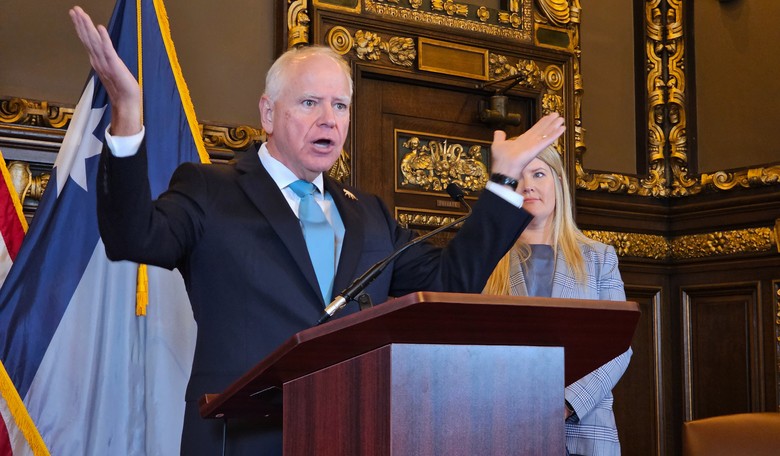
Yet several Democratic governors—including Wisconsin Gov. Tony Evers, Arizona Gov. Katie Hobbs, Minnesota Gov. Tim Walz, Oregon Gov. Tina Kotek, Hawaii Gov. Josh Green, and New Mexico Gov. Michelle Lujan Grisham—have either rejected participation, vetoed legislation that would authorize it, or resisted signing their states on.
Why would a governor reject federal tax-credit-funded scholarships that could help children in public, charter, private, religious, or homeschool settings?
Perhaps their relationships with teachers unions offer part of the answer.
Gov. Evers of Wisconsin has long enjoyed support from organized labor and teachers unions, including the American Federation of Teachers. In March, he vetoed legislation that would have brought Wisconsin into the federal scholarship program, claiming it would harm public education.
But allowing families to receive privately funded scholarships does not take money out of Wisconsin’s existing education budget. It simply gives parents another option.
Gov. Hobbs made a similar decision in Arizona, vetoing legislation in April that would have opted the state into the program. That decision came as the Arizona Education Association publicly backed her reelection, praising her commitment to public education and educators.
Apparently, protecting the government education monopoly matters more than letting Arizona families access additional educational support.
Oregon presents an especially interesting case. Kotek previously received enormous support from the Oregon Education Association, which contributed roughly $389,000 to her 2022 campaign. But in 2026, the union’s political arm voted not to endorse any current candidate for governor, including Kotek.
Perhaps rejecting school choice is Kotek’s attempt to win back the union. After all, when a powerful political organization that once spent hundreds of thousands of dollars helping elect you decides to withhold its endorsement, there is a clear incentive to prove your loyalty.
Hawaii and New Mexico tell the same story.
The Hawaii State Teachers Association endorsed Green in 2022, calling him a strong supporter of the state’s public schools. The American Federation of Teachers New Mexico also endorsed Lujan Grisham for reelection. Both governors initially rejected the federal program, although their administrations later indicated that they were reconsidering their decisions.
Then there is Minnesota.
Frankly, considering Minnesota’s recent history of massive fraud involving government-funded programs, perhaps American taxpayers should be relieved that Tim Walz will not be placed anywhere near another pot of money. Besides, Minneapolis’ Quality “Learing” Centers have already mastered Somali fraud fundraising, so they seem to be set.
Still, families should not lose an educational opportunity because state officials have failed to protect taxpayer dollars elsewhere.
Several governors have delayed making a final decision. New York was once among them, but Democrat Gov. Kathy Hochul ultimately broke with teachers unions and announced support for participation. As Hochul faces reelection this November, she appears to be making a clear appeal to moderate voters. Teachers unions have nowhere else to go politically—especially when her opponent, Bruce Blakeman, is willing to ask why New York spends more than $30,000 per student on an education system that remains mediocre and, frankly, is failing too many children.
The case for school choice has already been made. Students who attend choice programs in Washington, D.C., have experienced stronger graduation outcomes and lower rates of criminal activity than comparable students who remained in traditional public schools.
In New York City, Success Academy charter schools have repeatedly achieved proficiency rates far above the citywide average, despite serving primarily low-income and minority students.
But the argument does not ultimately depend on a single school network or a single set of test scores. It comes down to a basic question: Who should decide where a child is educated—the child’s parents or politicians influenced by public-sector teachers unions?
The core of conservatism is a fundamental distrust of concentrated government power. That principle is also central to America itself. It is why the country has federalism, checks and balances, the separation of powers, and a Bill of Rights.
Our system was not designed around the belief that government officials always know best.
Education shapes a person’s beliefs, character, opportunities, and future more than any other institution. Yet Democrats continue to argue that the government should control where education dollars go, even when accepting this program would require no new state tax and no sacrifice from existing public-school budgets.
Parents know their children better than governors, union leaders, education bureaucrats, or school-board officials ever will. They know whether their child is thriving, falling behind, being bullied, or simply needs a different environment. It is time to return educational power to the people who have the greatest stake in a child’s success.
Governors who reject this program are not rejecting Donald Trump. They are rejecting parents—and denying children opportunities simply to protect the political system that keeps them in power.