
Editor's Note: The following piece is an excerpt from Scott's upcoming book Why Social Justice Is Not Biblical Justice: An Urgent Appeal to Fellow Christians in a Time of Social Crisis.
The horrific murder of George Floyd has renewed a sincere cry from many evangelical leaders to speak out against racism in America.
Racism is a great and ever-present evil. As followers of Jesus, we must uphold the truth that all people, regardless of skin-color, ethnicity, sex, or socio-economic status, are made in God’s image, with inherent worth and dignity. Nearly all evangelical Christians agree on this point. Here is where we begin to disagree: we no longer have an agreed-upon understanding of what racism is.
In a conversation I had with an evangelical pastor a few years ago, he suggested that racism was “prejudice plus power.” It only applies to white people, who, as he put it, hold a monopoly on cultural power. I had always understood racism as “the belief that race is the primary determinant of human traits and capacities and that racial differences produce an inherent superiority of a particular race” (Merriam Webster).
These are wildly divergent definitions. If you hold to the first, white people are, by definition, racist because they benefit from unearned privileges based on their supposed cultural dominance.
If you hold to the second definition of racism, then the first definition is, itself, racist, because it lumps people together based on their skin-color and problematizes them.
These two definitions are part of two larger, competing narratives about race in America today. Understanding these narratives is key to understanding the highly-charged racial climate we find ourselves in. Both narratives have roots in the black community. Both have historic and present-day black champions. Let’s examine the broad outlines of these two opposing narratives.
The Revolutionary Narrative
I’ll call one The Revolutionary Narrative. According to this narrative, existing systems and structures are so corrupted by racism that there is no possibility for reform. They need to be torn out root and branch to make way for a new social, economic, and political order.
The Revolutionary Narrative is rooted in an academic field called Critical Race Theory. It is the exclusive narrative taught in our public schools and universities, and aggressively promoted in mainstream and social media, as well as through the entertainment industry, big business, and increasingly, through evangelical institutions and universities.
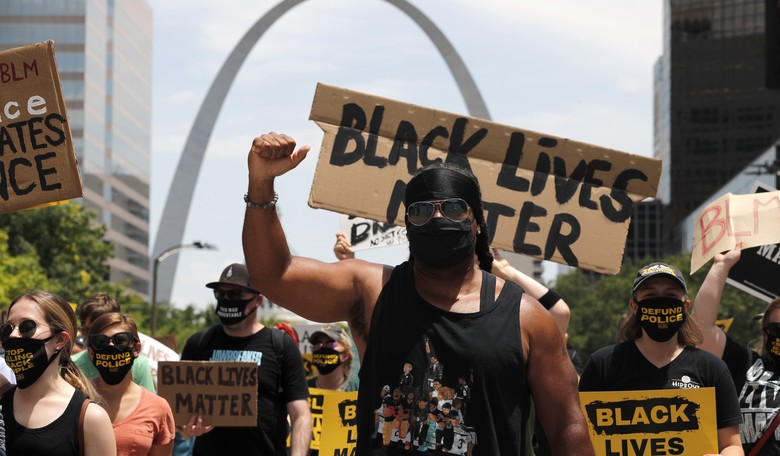
Historically, versions of the Revolutionary Narrative were championed by the likes of W.E.B. Du Bois, James Baldwin, and Malcolm X. Contemporary popularizers include Robin DiAngelo, and Barbara Applebaum, academic pioneers of “Whiteness Studies,” Michelle Alexander, author of The New Jim Crow, Atlantic essayist Ta-Nehisi Coates, New York Times Journalist and head of the 1619 Project Nikole Hannah-Jones, and Black Lives Matter founders Alicia Garza, Opal Tometi, and Patrisse Cullors, to name just a few.
Here is an abbreviated summary of the Revolutionary Narrative:
- It emphasizes systemic injustice and institutional racism. The problems black people face are sourced outside their community, in the larger society, and attributed to historic slavery and pervasive, systemic white oppression.
- Needed changes in the black community require white people to change. They need to own up to their “whiteness,” confess their complicity in oppression, and not defend themselves in any way. Doing so only demonstrates their “white fragility.”
- The biggest problems facing the black community today are near-genocidal levels of police brutality and a systemically racist criminal justice system, which Michelle Alexander describes as “The New Jim Crow,” as demonstrated by the fact that black people are arrested and imprisoned at a far higher rate than white people (relative to their share in the overall population).
- America, from its very origins, is a fundamentally racist nation. Our history is defined by structural and systemic white racism and oppression against blacks, Native Americans, and other minorities. To this day, systemic white racism continues to reside in the very “DNA” of our nation.
- “Color-blind” is a racist sentiment. Those who use it demonstrate their insensitivity to the oppression, violence, and discrimination black people face. We need to be more aware of the countless ways skin color divides us, not less.
- #BlackLivesMatter, and its advocacy against rampant police brutality, is the single most important civil rights movement in America today.
The Preservation Narrative
Most of us are aware of the Revolutionary Narrative. But there is another race narrative that doesn’t get nearly as much attention. Far fewer people are familiar with its broad outline or its most prominent advocates. I’ll call it The Preservation Narrative. It affirms the goodness of the principles on which America was founded and seeks to preserve them while continuously working to reform our systems and institutions to more perfectly reflect these principles.
While the advocates of the Revolutionary Narrative would have you believe that the Preservation Narrative isn’t authentically “black,” this isn’t true. It has deep roots in the black community. Historically, it was championed by people like Frederick Douglass, Booker T. Washington, George Washington Carver, Jackie Robinson, Jessie Owens, and Martin Luther King Junior as exemplified in his famous “I Have a Dream” speech.
Today, its most outspoken advocates are also black. They include Supreme Court Justice Clarence Thomas, former presidential advisor Robert Woodson, economists Thomas Sowell and Walter Williams, conservative author Shelby Steele, former Secretary of State Condoleezza Rice, Vanderbilt political science professor Carol Swain, South Carolina Senator Tim Scott, neurosurgeon Ben Carson, author and activist Alveda King, Wall Street Journal columnist Jason Riley, firebrand cultural critic Candace Owens, entertainer Kanye West, Harvard economist, and author Glenn Loury, to name a few.
Here is my summary of the Preservation Race Narrative:
- It emphasizes individual dignity, personal choice and responsibility. White racism persists, but it is far from the biggest challenge confronting the black community. Those challenges can be overcome by the actions and decisions of black people themselves with success not ultimately dependent on the actions of white people.
- The biggest challenges facing the black community today are: (1) The devastation of the black family. Fatherless households went from 35% in 1970 to 72% today. This has produced several generations of fatherless, alienated young men who struggle educationally, economically and socially and turn to criminal activity. (2) Abortion, which, plagues America in general and claims 259,336 black lives every year. (3) An educational system that traps far too many young people in failing schools and gives them no opportunity to opt out and choose schools that would improve their educational opportunities.
- Black economists Walter Williams and Thomas Sowell argue that the devastation of the black family is largely attributable to the rise of the modern welfare state, which financially incentivizes single-parent households. According to Sowell, “the black family, which had survived centuries of slavery and discrimination, began rapidly disintegrating in the liberal welfare state that subsidized unwed pregnancy and changed welfare from an emergency rescue to a way of life.”
- America has a tragic history of racial oppression and slavery which has caused real and ongoing damage to the black community. Yet our founding principles in the Declaration of Independence led to the eventual eradication of slavery and significant progress in racial equality. Today, America is one of the least racist countries in the world, and a land of opportunity for people of all ethnic backgrounds, which is why immigrants continue to flock to this country in huge numbers, including many with black and brown skin.
- “Color-blind” is a cultural achievement to be celebrated. It frees us from the scourge of tribalism. Rather than generalizing about people based on race, “color-blind” means seeing people first and foremost as unique individuals with agency and responsibility. This was Martin Luther King Junior's famous dream—that his children would not be judged by the color of their skin, but the content of their character.
- #BlackLivesMatter is a neo-Marxist revolutionary organization. It exists to exacerbate racial tensions as a means of dividing the nation, and fomenting social, cultural, and economic revolution.
Evaluating the Narratives
Like all narratives, truth can be found in both, but that is not to say that one is more truthful than the other.
As Christians, our obligation isn’t to further any particular narrative, but to truth and love. This means we have to evaluate both narratives carefully, affirming what is good and true and exposing what is false and destructive.
As I examine both narratives in this light, here are my conclusions.
View of human nature. The Revolutionary Narrative emphasizes victimization. The basic message is this: No matter how hard you try, you’ll never be able to get ahead because racist structures and systems are working against you. Likewise, if you are white, you are guilty of benefiting from these systems whether you realize it or not. I see this as a deeply unbiblical and destructive message. Any narrative that encourages people to view themselves as victims, and sources their problems in people with a different skin-color, is a horrible, false, and dangerous narrative.
The basic message of the Preservation Narrative is far more truthful in regards to human nature and far more empowering. Even if you face difficult challenges, you are not defined or limited by those challenges. As a human being, made in God’s image, you can make choices, and those choices matter in shaping your life, your community, and future history.
Beyond this, the Bible makes it abundantly clear that there is no class of innocent victims or guilty oppressors. All of us are fallen sinners, more than capable of doing the most heinous evil.
The Bible teaches that, regardless of skin color, all of us deserve punishment from a righteous God. All of us are in desperate need of God’s grace and forgiveness. Our greatest enemy is not people with different skin color, but the evil inside our hearts. Ultimately, the solution to our deepest problems is the Gospel—the hope of inward regeneration and reconciliation with God made available through the cross of Jesus Christ.
Police brutality. The Revolutionary Narrative continually repeats the generalized, hyperbolic charge of systemic police brutality. If this were true, we’d expect hundreds, or maybe thousands of black deaths at the hands of racist police officers each year. The reality is very different. In 2019, according to the Washington Post database of police shootings, in a nation of 330 million people, a total of 14 unarmed black Americans were fatally shot by police. Most of these were attacking police officers at the time.
We should be empathetic to the experiences black people have with the police, but we should also not perpetuate a myth. Affirming false beliefs is never a loving thing to do.
The criminal justice system. The Revolutionary Narrative indicts the criminal justice system as structurally racist based on the fact that more black people are arrested, charged, and convicted than white people when compared to their percentage of the overall population. But this analysis is deceptive. It ignores the fact that black Americans commit serious violent crime at rates over three times their representation in the general population. Blacks are not being arrested at higher rates because of their skin color but because of their behavior.
It wasn’t always this way. The dramatic rise of black crime parallels the breakdown of the black family starting in the 1960s and 70s. Crime rates inevitably rise when people of any skin color allow their capacity to self-govern to be eroded. Self-government is taught primarily in the family, the church, and the school. For the black community, all three of these institutions have been weakened in recent decades. The Preservation Narrative says that if we want to help the black community, we have to work to strengthen these vital institutions that impart virtuous self-government.
Abortion. Far and away, the biggest source of violent death in the black community is abortion. Yet nearly all proponents of the Revolutionary Narrative either downplay abortion as a social evil, or actively seek to expand the legalized murder of black children. This alone should prevent Christians from supporting the Revolutionary Narrative.
American history. As Christians, our approach to history must be based on truth. We must allow history to guide us, rather than manipulating and distorting history to further a particular agenda. To focus exclusively on one aspect of history—either the good or the bad—is to perpetuate a lie. Unsurprisingly, the Revolutionary Narrative, as typified by the New York Time’s 1619 Project, focuses only on the bad parts of America’s history. The Preservation Narrative agrees that America has a tragic history of racial oppression which has caused real and ongoing damage. Yet our founding principles in the Declaration made the eventual eradication of slavery and substantial racial equality possible. While racism and slavery are common among all nations, what makes America unique is our response to these evils. We eradicated slavery and have made tremendous progress since the Civil Rights era in addressing overt racism, and eliminating barriers to equal opportunity.
There are many parts of our history that we should celebrate. Yet the Revolutionary Race Narrative either whitewashes them out of the history books or downplays or ignores them because they counter the narrative. Here are a few examples:
- The world’s first organized anti-slavery society was formed in Pennsylvania in 1774, and the first legal ban on slavery anywhere in the world was in Vermont in 1777. Five of the original 13 states followed suit either during or immediately after the Revolution, passing bans on slavery between 1780 and 1784.
- Congress banned the slave trade at the first possible moment, in 1807, at the insistence of President Jefferson.
- Slavery was eventually abolished after a bloody civil war in which thousands of white people died to end this evil institution.
- We elected the first black president in 2009, and the whole country celebrated this milestone, even those who disagreed with Barak Obama’s policy positions, as I did.
A truthful take on our past also celebrates these facts, and remembers those who sacrificed to bring them about.
#BlackLivesMatter. As Christians, of course we agree that black lives matter. At the same time, we have to recognize that the organization that goes by this name is very discriminating in its advocacy for black lives. A select few matter—namely victims of white police brutality—but many more do not. When it comes to these black lives, the organization (BLM) is utterly silent:
- The millions of innocent black lives snuffed out through legalized abortion.
- The horrific number of black lives killed day-in and day-out as a result of inner-city and gang-related violence.
- The many black police officers killed in the line of duty.
- The many black children consigned to failing schools, with no choice to better their educational opportunities.
It isn’t hard to get accurate information on what Black Lives Matter stands for. Take time to read their website and examine their major funding sources. They are clearly a far-left revolutionary organization that uses race to further its revolutionary agenda. Here are a few things they advocate:
- The abolition of the nuclear family.
- A society that is “queer affirming” and supportive of LGBTQ+ rights.
- The expansion of abortion “services” in the black community.
- The abolition of free-market capitalism.
- The defunding of the police.
Despite this, many Christians of good conscience support Black Lives Matter simply because of the name. This is a mistake. The policies of Black Lives Matter only harm black people and fray the social fabric. Christians who truly wish to see flourishing in the lives and communities of their black brothers and sisters should consider supporting groups that strengthen black families and businesses, advocate for school choice, and fight against the scourge of abortion.
Tactics. Those advocating most forcefully for the Revolutionary Narrative employ tactics very similar to those used historically by Marxist revolutionaries. The narrative is sacrosanct. Call it into question, and you will be branded a racist. If you choose to remain silent, you will also be complicit in racism.
Anyone who dissents with the narrative can expect to be denounced and summarily bullied, shamed, intimidated, or threatened. Advocates of the Revolutionary Narrative have little interest in free, open debate. They want submissive compliance.
Christians should have nothing to do with these kinds of fear-based power tactics. We must remain a people committed to civility, respect, and free and open debate and dialogue in the pursuit of truth.
In my view, the Preservation Narrative is far more aligned to a biblical worldview and a truthful reading of U.S. history. The vast majority of its past and present black advocates are committed Christians. It diagnoses real problems, and proposes solutions aimed at addressing these problems in ways that will lead to the flourishing of the black community.
Scott Allen is President of the Disciple Nations Alliance. www.DiscipleNations.org.